A new operating model
for enterprise platform implementation.

Enterprise platforms went AI-native. Implementation didn't follow.
Trundl built the operating model that closes the gap,
with the engine that runs it.

The SaaS implementation industry lived off of three costly realities. None exist now.

Capture, configuration, and migration risk each used to consume a months of the calendar. AI changed the math.

01
Capture

01 Capture

Yesterday

Months spent in stakeholder interviews to map an environment.

Today

Context Captured in Hours. AI-aided discovery becomes self-healing and rapid.

02
Configuration

02 Configuration

Yesterday

Sprints of manual builds. Expensive tribal knowledge. Scope creep as a feature.

Today

Done in days. AI covers design for fit, governance, and configuration.

03
Migration

03 Migration

Yesterday

Weekend cutovers. Rollbacks and compromises no one could afford.

Today

Iterative and fast. Source and target connected while teams move at their pace.

Delivery is the IP.

Rapid Deploy Contextual Delivery's first to market model

Context-led

The customer’s environment is the input. No templates.

AI-orchestrated

AI runs across capture, build, and connect. Not at one step.

Contextual Delivery's first to market model

Audit, compliance, and change-control built into the configuration layer.

Outcome-priced

Fixed packages. Guaranteed delivery windows. The commercial model is the commitment.

Context drives changes in hours,
not from weeks of workshops

For thirty years, capturing how teams actually work required weeks of interviews using expensive resources. AI has changed the game, by ingesting SaaS configurations, documents, and transcripts you have. Change is now rapid.

AI configures. Experts verify.
You validate.

Most AI in enterprise services applies at one step: scripting, documentation, or test generation. They are productivity tools inside an unchanged delivery model. Contextual Delivery applies AI across the whole lifecycle: capture, build, connect. Your team validates each step live. The engine handles configuration. The team handles the business decisions. AI in the engine room. Human in control.

Audit, compliance, and change-control built in at configuration time.

Governance posture used to be patched on after deployment. Contextual Delivery models build it into the configuration layer. Every workflow ships with the audit trail required to defend it. Role-based access and change-control are generated during the build, not retrofitted by a separate team. Procurement reviews shorten by months.

Fixed delivery. Guaranteed windows. The model ensures the commitment.

AI-orchestrated

What gets delivered is contractually defined at signing. Price becomes much less sensitive to scope changes.

Guaranteed windows

7-15 business days, in writing. Use-case windows for enterprise programs, scoped in Discovery.

The handoff

A validated, working solution delivered rapidly, leaving budget and bandwidth for support and training.

Rapid Deploy is the first-to-market Contextual Delivery model.

Configured for the industries where generic deployments fail.

Toshiba moved 100 users across 8 teams off Smartsheet into Jira in a single day, from a 60-page WBS document. Workflow transformation was included in the package, not held back for a separate engagement.

ENTERPRISE PIPELINE

Multiple enterprise engagements are active across healthcare, financial services, and manufacturing. These are the regulated, multi-instance environments where labor-led delivery fails hardest.

CONNECTOR LIBRARY

Five connectors run today: Jira, JSM, Smartsheet, Asana, Freshservice. Each connector ships against a validated customer use case, not against a release schedule.

TOSHIBA · UAT IN TWO MEETINGS

Toshiba's teams were testing their own Jira by the second meeting.

0
teams
0
people
0
meetings to a testable system

Hours

to a working config

Toshiba’s hardware commercialization ran on a legacy no-code tool that couldn’t scale to enterprise governance. Leadership mandated a move to Jira, without disrupting programs already in flight.

From the process docs and meeting transcripts Toshiba already had, Rapid Deploy stood up a working Jira instance: their project structures, phases, custom fields, workflows, dashboards, and per-team boards, matched to their hardware lifecycle.
By the second meeting, teams were validating a live system that mirrored how they already worked, with portfolio rollups in place. They refined a real instance instead of debating a spec, which sped adoption and cut change resistance.
We anticipated months to build a custom Jira solution. Rapid Deploy analyzed our meeting transcripts and delivered a sandbox-ready configuration within hours of our second meeting.

Jim Hawk,

Toshiba Global Commerce Solutions

The argument your diligence team can pressure-test.

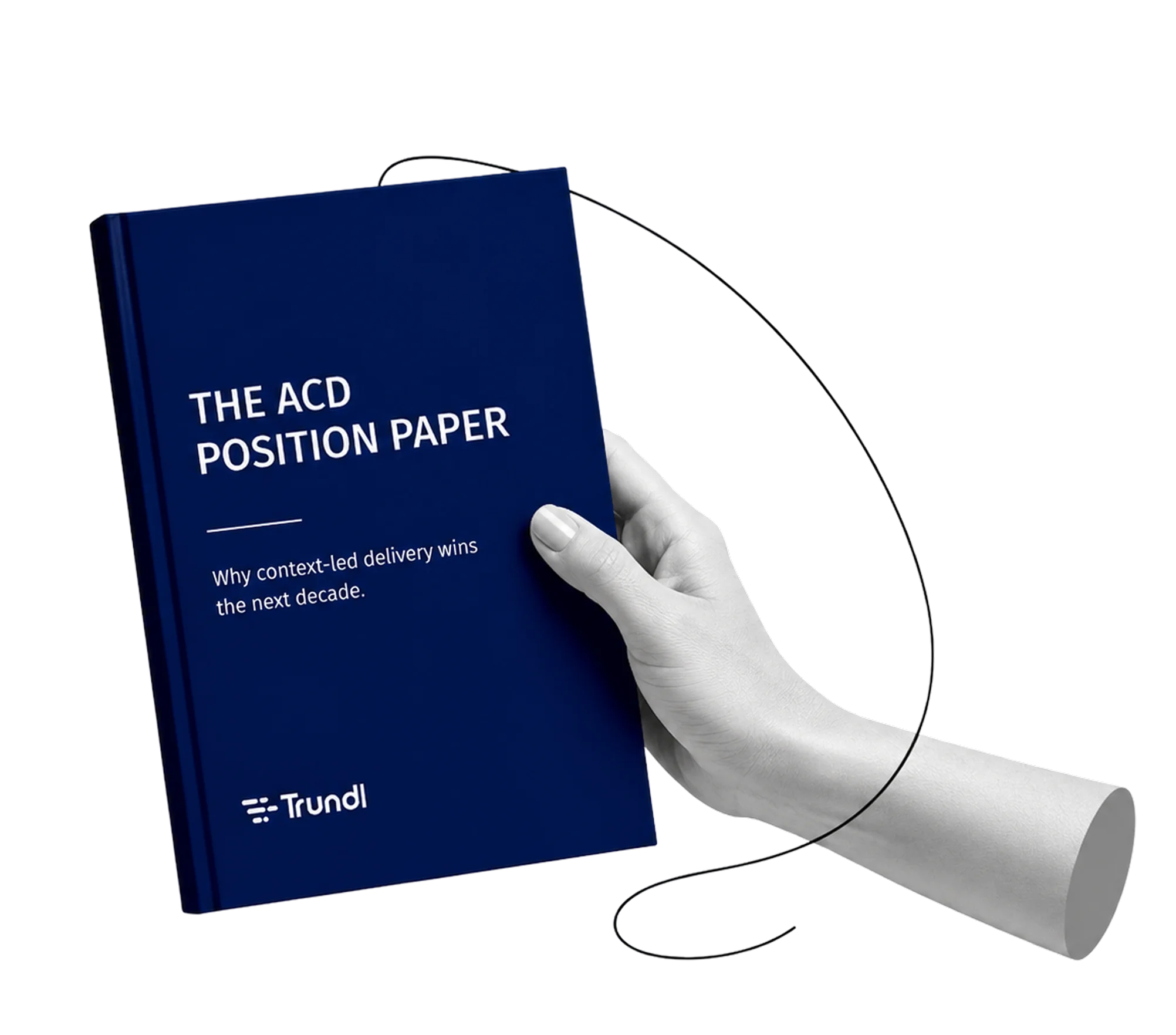
The Contextual Delivery Foundational Whitepaper argues that context-led delivery is the operating model the next decade of enterprise platform implementation will run on. It describes the four operating principles in detail, models the economics of the shift, and makes the case for moving your next engagement onto Contextual Delivery.

"Owning context, where data and conversations live, is the differentiator and key to winning AI-driven work."

Patrick Howell,

Co-CEO, Trundl

Thirty minutes. Bring your roadmap. We'll tell you whether Contextual Delivery fits.

Bring the program you’re scoping for the next two years. We’ll map the 90-day path.

Common questions.

What is Contextual Delivery?
Contextual Delivery is the operating model that turns business context into production-ready systems in days, governed by design and priced on outcomes. Trundl pioneered the category. Rapid Deploy is the first Contextual Delivery engine for Atlassian, monday.com, and Microsoft.
Labor-led delivery is metered by hours billed against scope, methodology decks, scope creep as a structural feature of the engagement. Contextual Delivery is context-led. The engine reads the environment or supplied context from the customer, it designs and builds the configuration with human-in-control AI features, it governs it at the configuration layer, and it prices on what gets delivered.
The beauty of Contextual Delivery is that it is a powerful approach any industry. The engagements Trundl is running today are concentrated in regulated, multi-instance environments where labor-led delivery fails hardest: healthcare technology, financial services, manufacturing, and any organization carrying multiple acquired entities through consolidation. However, since context is supplied by our customers, we can adapt this method for all industries.
Fixed packages with guaranteed delivery windows of 7 to 18 business days. Rapid Deploy Days are four-hour live build sessions with your team in the room. Post-handoff support and training included. The full engagement model lives on the How It Works page.
For these engagements, governance is built into the configuration layer, not patched on after. If the GRC documentation is shared with us, we incorporate it. Audit trails are generated for every configuration change. Role-based access and change-control are part of the workflow generation. ISO 27001:2022 certified, SOC 2 Type II compliant, GDPR aligned.

Rapid Solutions from Trundl .

Migration²

The platform move and the workflow transformation, in one engagement.

CSX²

ITSM into ESM and CSM, on one platform.

AI²

Governed AI rollout on your platforms.